BUCKETMAN
Manual
v2.0.0 · VST3 + AU + CLAP · macOS (Universal) + Windows 10+ (VST3 + CLAP)
What it does
BucketMan is a model of a vintage analog delay, measured against a real unit. Its bucket-brigade delay line is paired with a companding noise-reduction stage and an internal modulation. The modulation turns the echo into a chorus or a vibrato, and at high FEEDBACK the delay self-oscillates.
BucketMan models the whole chain: the clock, the filters, the noise and the drift of the real chip, with a compander that squeezes and expands every repeat the way the original does. At long delay times the line gets darker and a little grainy, as the hardware did. Three modes let you choose the condition of the machine, from factory-fresh to twenty years in a garage.
The Deluxe Memory Man legacy
The Deluxe Memory Man — the version this plugin models — was designed by Howard Davis at Electro-Harmonix in the late 1970s. Built to fake a tape echo, it became a sound of its own.
The Edge used a Deluxe Memory Man with a Vox AC30 on early U2 recordings. The delay line of the pedal is made of two MN3005 bucket-brigade chips, with an NE570 compander.
BucketMan models the full DMM signal chain — bucket-brigade, compander, LFO, and the aging instabilities that make each unit slightly different. Three modes (Stock / Serviced / Aged) cover the spectrum from factory-fresh to vintage worn.
Parameters
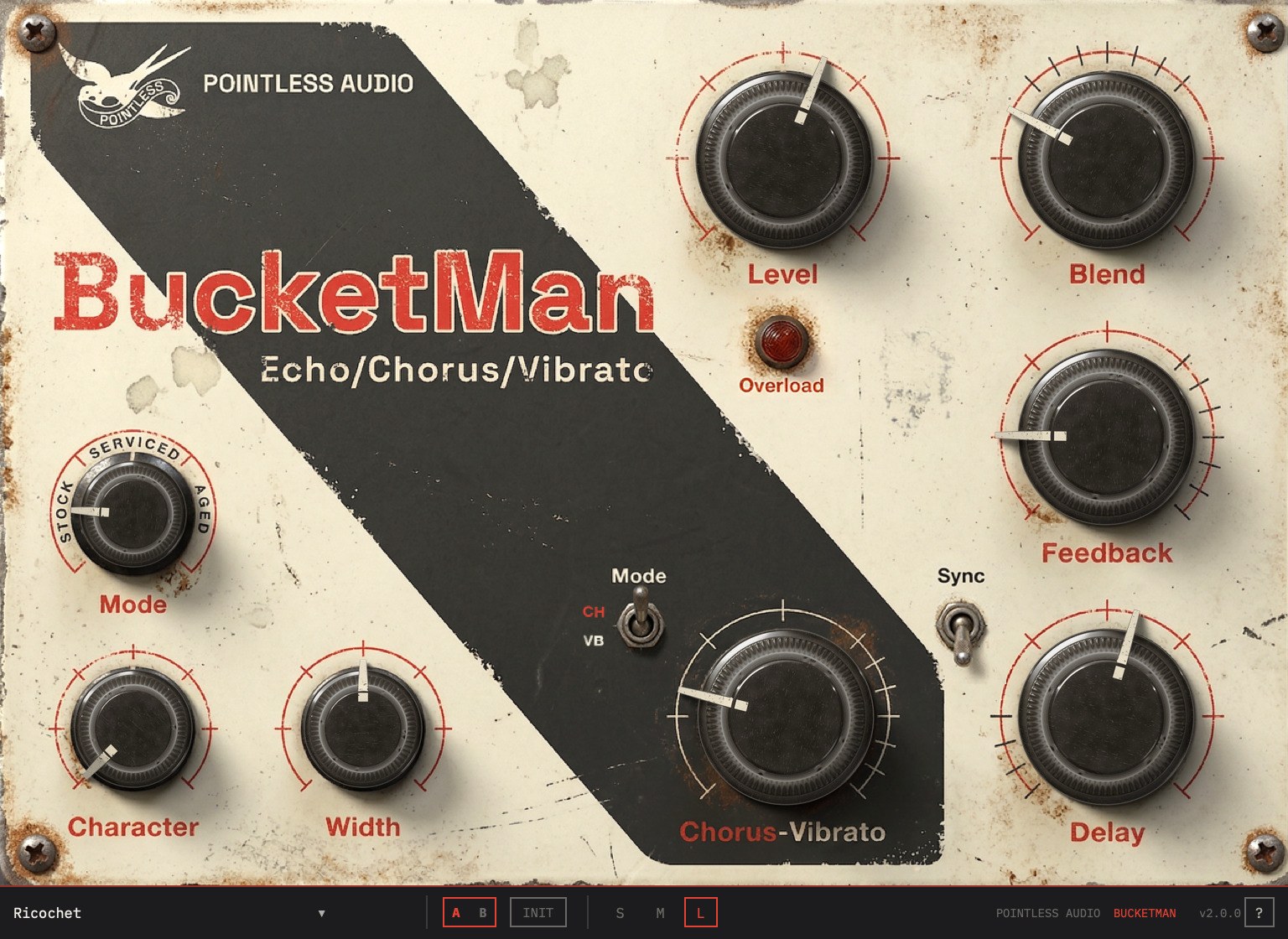
BucketMan's controls fall into four groups: the delay core, the modulation, the machine's character, and tempo sync. Everything is automatable. Your host shows the values in real units: DELAY in milliseconds (or the division name with SYNC on); FEEDBACK and DEPTH as a percentage of the knob travel; BLEND, WIDTH, CHARACTER and DEGRADE as a percentage; LEVEL in dB relative to 12 o'clock. Hover over a knob, or drag it, and the panel shows the same value in a bubble. The defaults below are what you see when you open the plug-in: they are the settings of the first factory preset, Ricochet.
The host lists the parameters as DELAY, FEEDBACK, BLEND, LEVEL, WIDTH, DEPTH, CHR/VIB, CHARACTER, MODE, SYNC, BYPASS and DEGRADE. The panel labels the DEPTH knob «Chorus-Vibrato» and the CHR/VIB switch «Mode», with the positions CH and VB. DEGRADE has no control on the panel: the host can automate it, and it adds the line artifacts of the model (clock bleed, fold-back and non-uniformity). Only the Broken Unit preset sets it, to 35%.
CORE
| Parameter | Range | Default | What it does |
|---|---|---|---|
| DELAY | 37-470 ms | 300 ms | Delay time, with the knob travel of the original. Longer settings sound darker and grainier |
| FEEDBACK | 0-100% | 17% | How many repeats. The delay self-oscillates from about three-quarters of the travel |
| BLEND | 0-100% | 27% | Dry / repeats balance. Dry only below about 8%, repeats only above about 91% |
| LEVEL | -20.6 to +12.8 dB | +3.4 dB | Input drive and output level. 0 dB at 12 o'clock |
| WIDTH | 0-100% | 50% | Stereo spread of the repeats. 0 = mono |
DELAY — sets the repeat time, from 37 to 470 ms, following the knob travel of the original: at 12 o'clock it sits at about 273 ms. The longer the delay, the slower the clock of the bucket-brigade line, so each repeat loses more top end and picks up more aliasing: that is the grain of long settings.
FEEDBACK — how many times the signal repeats. At low settings you hear a slap or a couple of echoes. From about 73% of the travel the repeats stop decaying and the delay self-oscillates; above that it grows more intense.
BLEND — the balance between your dry signal and the echoes. Below about 8% you hear only the dry and above about 91% only the repeats, because the control follows the potentiometer of the original, which has a dead zone at each end. Halfway, dry and repeats each sit about 9 dB below their full level. The line adds a very low background hiss to the repeats: at the default settings the floor measures about -110 dBFS. The hiss belongs to the repeats, so it fades as BLEND comes down and it is gone when only the dry is left. With a silent input and BLEND below about 8%, or in bypass, the output is digital silence in Stock and Serviced. In Aged, mains hum is added after the blend and stays at any BLEND. BLEND works the same in chorus and vibrato: vibrato does not take the dry out.
LEVEL — the input drive and the output level together. It acts on the dry and on the repeats, and follows a table taken from the original: -20.6 dB at the bottom, 0 dB at 12 o'clock, +12.8 dB at the top, 33.4 dB in all. LEVEL at zero is not off: it sits 33.4 dB below the maximum, and the repeats and the self-oscillation are still there. Below 12 o'clock LEVEL also works as a volume on the repeats after the delay line, so a saturated repeat can sit under the dry: on a repeat at -1 dBFS the knob spans about 21 dB. From 12 o'clock up it drives the line harder, which thickens the repeats, and pushes the dry into the soft clipping of the original. With LEVEL at 0 dB, BLEND at 50% and FEEDBACK at zero, the output level is within 1 dB of the input level. A safety ceiling at 0 dBFS limits peaks and leaves signals below -1 dBFS untouched.
WIDTH — the stereo spread of the repeats. The modulation of the right channel is shifted against the left by WIDTH times 180 degrees: at 100% the two sides move in opposite directions, and at 0% the repeats are mono. The return is a single loop, as on the original: WIDTH changes how wide the repeats sound, never how long they ring, and the repeats do not pump in level when WIDTH is open. The dry stays centred.
MODULATION
| Parameter | Range | Default | What it does |
|---|---|---|---|
| DEPTH (panel: CHORUS-VIBRATO) | 0-100% | 22% | Modulation depth: pitch wobble on the repeats |
| CHR / VIB (panel: Mode, CH / VB) | toggle | CHR | Chorus (0.70 Hz, up to 19 ms deep) or Vibrato (5.28 Hz, about 3 ms deep at DELAY 273 ms and full DEPTH) |
DEPTH — the depth of the pitch wobble on the delayed signal. At 0% the repeats are steady. The default of 22% is what the host and the bubble show for the stored value 0.05, because DEPTH is displayed as the position of the knob. The depth of the wobble follows DELAY, as on the unit we measured: in CHR it grows with the delay time; in VIB it is deepest around the middle of the DELAY range and shallower at both ends.
CHR / VIB — switches the modulation between two characters. CHR is the slow, wide one: 0.70 Hz and up to 19 ms peak to peak. VIB is the fast, narrow one: 5.28 Hz and about 3 ms peak to peak at DELAY 273 ms and full DEPTH. The dry signal stays put in both, and both are stereo unless you pull WIDTH to zero.
CHARACTER
| Parameter | Range | Default | What it does |
|---|---|---|---|
| CHARACTER | 0-100% | 0% | How worn the compander is |
| MODE | Stock / Serviced / Aged | Stock | The machine's overall condition |
CHARACTER — the age of the compander, as a mismatch between its two halves. At 0% they match, as in the measured unit. As you turn it up, the expander follows the signal more slowly than the compressor and it takes more of the quiet parts away. Three things follow. The start of a note digs in deeper and for longer: in the model, a note starting 30 dB above the level before it dips by 2.7 dB over 14 ms at 0% and by 6.9 dB over 52 ms at 100%. The tail after a drop in level lasts longer. The repeats of a short note die away sooner: in the Ricochet settings, about 2.8 dB more per repeat at 100% than at 0%. CHARACTER adds no noise, saturation or darkening of its own, and it does not depend on MODE.
MODE — three versions of the same machine at different points in its life. Click the knob to go to the next one, click a name on the panel to select it, drag the knob to step through them, or use the mouse wheel. Bandwidth, aliasing, delay time (to within 1.5 dB) and the dry signal are the same in all three.
| Mode | What changes |
|---|---|
| Stock | The measured unit |
| Serviced | Recapped and calibrated: noise about 10 dB lower than Stock, about 4 dB more headroom before the line distorts, second harmonic about 10 dB lower |
| Aged | Twenty years in a garage: noise about 8 dB higher than Stock, mains hum at 50 Hz and its harmonics (only in this mode), about 3 dB less headroom, second harmonic about 7 dB higher |
SYNC
| Parameter | Range | Default | What it does |
|---|---|---|---|
| SYNC | toggle | Off | Locks DELAY to the host tempo |
With SYNC on, the DELAY knob snaps to eight musical divisions of the host tempo, ordered from short to long: 1/16 triplet, 1/16, 1/8 triplet, dotted 1/16, 1/8, 1/4 triplet, dotted 1/8, 1/4. If the host sends no tempo, BucketMan uses 120 BPM. The line goes up to 600 ms; past the 470 ms of the knob it runs slower, so the repeats get darker and rougher, like a slower clock. When a division would be longer than 600 ms, BucketMan plays the longest one that fits and the value bubble says so (for example «1/4 → 1/8D»): below 100 BPM a quarter note is replaced. Changing division while the echoes ring crossfades over 40 ms, with no jump in pitch. When the two readings are 180 degrees apart in phase, a sine can cancel for about 3.6 ms in the middle of the crossfade.
BYPASS
Bypass passes the signal through unprocessed, with no repeats and no tail, after a 10 ms crossfade. It is aligned with the plug-in's latency (your DAW compensates) and it empties the delay line once it has settled, so no old repeats come back when you switch it off.
Factory presets
All ten presets were retuned on the new laws. Against 1.2.29 they match, within the tolerances of our test, the decay per repeat (1.5 dB), the level of the first echo against the dry (1 dB) and the output level on a guitar (1 dB). CHARACTER is set preset by preset and is not part of that match. Only Runaway self-oscillates; its level in self-oscillation is within 2 dB of the 1.2.29 plateau. These figures come from a gate on the 2.0 factory presets against 1.2.29, with a 1 kHz burst; the test of old sessions under Opening old sessions, below, converts 1.2.x settings and measures a different burst and the output level on a guitar, so its numbers (for example Runaway at +2.2 dB) are a different measurement and are not comparable one to one.
| # | Preset | Description |
|---|---|---|
| 1 | Ricochet | 300 ms, short tail: every control at its default. The preset BucketMan opens on |
| 2 | Slap | 120 ms, a single repeat, CHARACTER 10%. Serviced |
| 3 | Molten Chorus | 170 ms, chorus at 87% depth, FEEDBACK 54%. Serviced |
| 4 | Seasick | 200 ms, vibrato at 87% depth, CHARACTER 100%: the repeats waver in pitch. Stock |
| 5 | Runaway | FEEDBACK 81%: self-oscillates. The only preset that does |
| 6 | Sunday Morning | 285 ms, FEEDBACK 14%: the first echo sits about 4 dB under the dry. Stock |
| 7 | Quarter | 469.8 ms, the longest delay time. Chorus at 59% depth, CHARACTER 15%, WIDTH 20%. Stock |
| 8 | Infinite Hallway | 445 ms, FEEDBACK 68%, vibrato at 77% depth, WIDTH 70%. Serviced |
| 9 | Broken Unit | 230 ms, vibrato at 84% depth, CHARACTER 80%, DEGRADE 35%. Aged |
| 10 | Ghost Notes | 390 ms, chorus at 89% depth, CHARACTER 100%, WIDTH 60%: the first echo sits about 6.5 dB under the dry. Stock |
Overload LED
The red LED shows how hard the signal — dry plus repeats — is hitting the delay line. It is not a FEEDBACK meter: it lights 3.6 dB below the level at which the line clips, and it is off in bypass.
| Frame | Meaning |
|---|---|
| 0 | Below the threshold — nothing happening |
| 1-6 | The signal entering the line climbs from the threshold to 4.3 dB above it |
| 7 | 4.3 dB or more over the threshold |
Use it to set LEVEL: it lights on the loudest notes, and with it in the top frames the line is at the clip level or above.
How it works
You don't need any of this to use BucketMan — but if you're curious what's inside the box:
The bucket brigade is where the delay comes from. Instead of a clean digital buffer, the signal is passed hand-to-hand down a long chain of analog stages (8192 cells, two chips), sampled by a clock that slows down as the delay gets longer. That is why the repeats get darker and grainier the longer the delay.
The compander fights the noise that chain would otherwise add: it squeezes the signal on the way in and expands it on the way out, as a pair. At CHARACTER 0 the pair is matched, which is why the repeats keep the same decay whether you play quietly or hard. The dip you hear at the start of a note comes from how fast the expander reacts; CHARACTER mismatches the pair, and MODE sets how worn the whole machine is.
The modulation is an internal oscillator wobbling the delay time: 0.70 Hz in CHR and 5.28 Hz in VIB. A little of it turns the repeats into a chorus (CHR); switch to VIB and it becomes a faster, narrower vibrato. Push FEEDBACK far enough and the repeats stop decaying and bloom into self-oscillation.
It's a model of the circuit rather than a tidy algorithm, which is why it drifts, darkens and, at high FEEDBACK, runs away.
Design notes
The repeats darken at the clock. The filters of the original barely move across the delay range; what changes with longer delays is the clock. A slower clock lowers the top end (at 4 kHz by about 5 dB between the shortest and the longest delay) and adds the aliasing you hear on long repeats, and that grain is part of the sound.
The compander sets the decay. The two halves of the compander are a matched pair at CHARACTER 0, as in the original circuit; the dip at the start of a note lives in how fast the expander follows, and, with CHARACTER up, in how worn the pair is.
Three modes, one circuit. Stock, Serviced and Aged are the same hardware at different points in its life, with Stock being the measured unit. The circuit doesn't change — only how worn the components are.
Vibrato is stereo. BucketMan keeps vibrato in stereo; set WIDTH to zero if you want a mono pitch-shift.
Installation
macOS
Double-click the PA_BucketMan_v2.0.0_macOS.pkg installer and follow it — the Customize step lets you pick VST3, AU and CLAP (for Bitwig, Reaper, MultitrackStudio). Formats install system-wide to /Library/Audio/Plug-Ins/VST3/, Components/ and CLAP/. Restart your DAW.
Note: The installer is signed with an Apple Developer ID and notarized by Apple — macOS opens it directly, with no security warnings.
Upgrading from 1.2.x
BucketMan 2.0.0 installs over 1.2.x. Sessions and your own presets saved with 1.2.x are converted as they load: LEVEL, BLEND and FEEDBACK are remapped, CHARACTER is set to 0, and SYNC keeps the same division. 1.2.x projects open converted automatically and sound close to the original, within about 2.5 dB of level in our test on 15 states (10 within 1 dB, 12 within 2 dB, the worst at 2.2 dB); the exceptions below apply. A session saved on an untouched factory preset of 1.2.x reopens on the 2.0 preset of the same name, with that preset's CHARACTER. A few things change by design:
- DELAY: 20 ms becomes 36.9 ms, and anything above 469.8 ms becomes 469.8 ms.
- LEVEL: 1.2.x went down to silence, 2.0 stops 33 dB below the maximum. A 1.2.x LEVEL below about 20% of its travel cannot be reached: the session opens at the bottom of the 2.0 LEVEL, where 1.2.29 went down to −41 dB and to silence at zero. A session with LEVEL below about 30% can open louder than before; between 30% and 35% with a lot of BLEND it can open up to about 2.4 dB away from where it was. We did not measure the size of the difference between 20% and 30%.
- CHARACTER: it is set to 0 on opening, and now means the age of the compander; its default is 0.
- Chorus and vibrato: at the same DEPTH the chorus is deeper and the vibrato is faster.
- The conversion of LEVEL, BLEND and FEEDBACK is tuned on MODE Stock and WIDTH at 50%: in Serviced a converted session comes out about 1.5 dB louder, in Aged about 2 dB quieter; with WIDTH high the 1.2.x tail was shorter, while 2.0 has a single feedback loop like the original.
- FEEDBACK saved at 0.70 or above on the 1.2.x scale (77% of the knob travel) gives a shorter tail than in 1.2.x; between 0.815 and 0.84 (86% to 88% of the travel) 2.0 already self-oscillates.
- The first echo of a hard, sharp attack is lower than in 1.2.x: that is the compander of the original, which dips on the attack. On a burst, in the 15-state test of 10/10, the first echo sits 5.6 to 10.6 dB lower against the dry.
- MODE: Aged adds mains hum; Serviced is cleaner, not brighter.
- WIDTH no longer shortens the tail, and the repeats no longer pump with it open.
- With SYNC on, a 1.2.x session saved on a dotted 1/4, a 1/2 or a whole note reopens on 1/4: the 2.0 divisions stop at 1/4 (600 ms at most).
- The first factory preset, "The Edge", is now "Ricochet".
Automation lanes are not converted: curves written for LEVEL, BLEND, FEEDBACK and DELAY are read with the new laws, and with SYNC on the divisions are in a new order. If a session doesn't sound right, set MODE and CHARACTER again, check LEVEL, and compare with a factory preset. Sessions saved by 2.0 open unchanged.
Windows
The package contains both formats: install the one your DAW uses, or both.
- VST3: copy the
PA BucketMan.vst3folder toC:\Program Files\Common Files\VST3\. - CLAP: copy the
PA BucketMan.clapfile toC:\Program Files\Common Files\CLAP\.
Note: SmartScreen may warn — click "More info" → "Run anyway". Windows binaries are not Authenticode signed.
Troubleshooting
Self-oscillation runs away at high FEEDBACK — by design. It starts at about three-quarters of the knob travel (73%); above that the behaviour is intentionally wilder. Pull back a little for sustained chaos without blowing up. At the very top of the travel the self-oscillation is stable, but its slow swell is about 2.9 dB deep (CHARACTER at 0), against 16-19 dB at 0.33 Hz on the unit we measured.
A meter shows a signal with no input — with BLEND above about 8% the delay line adds a hiss at about -110 dBFS. In Aged, mains hum is added after the blend and stays at any BLEND. Bypass and BLEND at 0 give digital silence in Stock and Serviced.
Plugin doesn't appear in DAW — most DAWs rescan plugins on launch. In Logic Pro: Preferences → Plug-In Manager → Reset & Rescan. In Ableton: Preferences → Plug-Ins → Rescan. In Reaper: Preferences → Plug-ins → VST → Re-scan.
State doesn't persist between sessions — verify your DAW saves plugin state in the project. BucketMan uses APVTS standard, supported by every modern DAW.
Credits
- Modeled on a vintage analog delay (see the legacy section above). Measured against one real unit.
- Brand, name and visual language: Pointless Audio, 2026.
- The licence and the third-party notices are in
LICENSE.txt, in the package.
Support
Bug reports / feature requests: <[email protected]> · https://pointlessaudio.studio/support/ Web: https://pointlessaudio.studio
Pointless Audio pointlessaudio.studio
BucketMan is not affiliated with or endorsed by Electro-Harmonix / New Sensor Corporation. Electro-Harmonix, Memory Man, and Deluxe Memory Man are trademarks of New Sensor Corporation. This is an independent project inspired by the Electro-Harmonix Deluxe Memory Man.
© 2026 Pointless Audio · pointlessaudio.studio